Friday, May 20, 2022

Ups and Downs of Language Learning

 Learning the local language is one of the most essential components of living cross-culturally. There are many ways to go about learning the language. Communicating is almost as necessary as figuring out how to get food and water. Sometimes, a translator is the best and fastest way to settle in. Thankfully, English is becoming more and more common in Africa, especially in bigger cities! Basic English is often taught in schools, and when asked, most English-speaking locals say they learned from watching movies.

One of our goals while living in the “Horn of Africa” is to learn the language well! When we first arrived in the Horn in 2020, we had been invited by an underground Somali pastor to live in his city. We prayed about this opportunity and felt that living there for one year, focusing primarily on language, would be a good jumping-off point for us to move further east, deeper into the Somali region. When we moved, there was some tribal unrest in the town, especially in the Somali neighborhoods, so our house broker could not show us any houses there, but he could find us a place near the Somali community. We quickly realized that this town was not primarily a Somali town, as we had thought, but rather a good mix of many tribes. We needed to learn the local dialect to get around town, buy things at the market and shops, and pay our bills. We decided to spend a few months learning the local dialect, just enough to get the basics down before jumping into learning Somali.

At the time, devoting the first few months to a language, we did not plan on using long-term felt like such a setback! Having lived in North Africa for four years and learned Arabic there, I wasn’t sure I had the mental capacity to learn TWO more languages! This was not the language of the people the Father put on our hearts! This language will not be helpful once we cross the border! But! It really was necessary for us to get by where we were living, so we dug in! We learned enough to get by, and I was even able to make a few friends at a small market close to our house.

Like the rest of the world, we had a lot of ups and down in the summer of 2020! We both were down for the count for at least 2 weeks each with COVID. Our language helper was hospitalized with pregnancy complications. We traveled to the capital, all of which meant we spent a few months not doing any language learning. Thankfully, we ended the year with a few good months of Somali language lessons under our belts!

….And then we spent a Y E A R in the states!

Obviously, I have forgotten pretty much everything I learned in either language! It feels like we are starting over at square one, but that’s not entirely true! We now have a lot of experience learning language, we know our learning styles, what works and what doesn’t work for each of us, and we also learned that we differ in most of these areas, so having language lessons together is not the best option for each of us to thrive!

For me personally, I have (attempted to ) learn a language using what is called the “Growing Participatory Approach,” or “GPA” for short. This method thrives on immersion in the language and culture, using a local language helper versus sitting in a classroom and learning from a textbook. This is a structured approach to learning language in 6 Phases. Each phase eases you into the culture more and more as you go. In the first phase, you learn a lot of vocabulary and can say simple phrases. The second phase urges the learner to speak a little more and carry on simple conversations. Phase 3 focuses on the learner participating in cultural activities with the language helper, like going to the market together or making a local dish together, then spending the lesson time explaining in detail the steps of the activity. Often shared stories are implemented in this phase, stories that I am familiar with, and my language helper can read and then retell them to me so I can pick up on words I don’t know. I have even used some Bible stories during this phase in the past. Phase 4 is where the relationship with my language helper takes a deep dive, and she shares her personal life story with me. Phase 5 is when the learner attempts to keep up with local to local conversations and listens to and understands local radio or news programs. Finally, Phase 6 are steps to take to continuously learn the language and culture.

Once again, I find myself in Phase 1 and have been doing a lot of listening! Actually, for the 100 hours of lessons, it is advised that the learner not speak much! This is modeled after how we learn naturally; a baby listens to others speaking for a long time before ever uttering a word! During the first phase, we use small flashcards, and the language helper points to one picture and says the word repeatedly. We add a few more pictures at a time, and then the helper asks where is ___, and I point to whichever word she says. This is how we gain a lot of vocabulary very fast! I record every lesson to relisten to them later when I study.

Since arriving in February, I have spent a few hours a week listening to my old language lesson recordings and practicing the words with the locals we live with and when I am out and about in the city.

Fuzzy and I have been pretty busy leading training and focusing more on the ministry side of our work in this season and not focusing as much on language learning. We again have found ourselves in a place that requires us to use the local language, and are not able to focus on Somali just yet. I have been feeling a little stressed about being here for 3+ months, and I’m still stringing short phrases together or using one or two words that I know and a lot of pointing! Last week I decided to crack down on and spend a significant amount of time listening to my language recordings. After a few days of this, I felt like I was finally making teeny tiny baby steps of progress, and then all night, I dreamed in Arabic, a language I haven’t used in my daily life for 3 years! 😏 

Ahhh.. the life of a cross-cultural worker!


Friday, February 18, 2022

Coffee Culture


"Why don't American's like to have coffee with their friends?"

"We do!"

"No, no! You Americans always get your coffee to go and carry it around in sippy cups like toddlers! That's not how you're supposed to enjoy coffee!"

In this particular part of the Horn of Africa, coffee is more than just a hot drink or a caffeine jolt. It is an essential part of the culture, as you can tell by the previous conversation I had with a taxi driver. If you ask around, there are many stories about how coffee was first discovered here; most storytellers share some version of a shepherd who noticed his goats acting differently after eating coffee plants. I have not quite figured out how coffee plants and hyperactive goats have led to traditional coffee ceremonies, but somehow, it has become embedded in the culture over time.

The traditional coffee ceremony entails many steps! There are no shortcuts, or 30-60 second brewing pods, suggesting that would probably be an insult. I had the privilege of spending an afternoon roasting, brewing, and enjoying coffee with Mia, my language helper. (Our language helpers teach us more than just language and are often the gateway for us to learn more about the culture and our neighborhood-but more on that later!)

Some might say the ceremony begins with lining the floor of the room, house, or patio with grass -but the women know it starts at the market! You must see the quality of coffee beans you want to purchase. You want to get fresh beans that are not too dry and shriveled, and when you pick up a handful, you want them to all be relatively the same size. Most sellers know the quality of the beans they are selling, and there are lots of buying options! If you can only afford the most miniature, cheapest beans, then buy just enough for one pot of coffee for now because even that is better than no coffee!

Once you've purchased your beans, it is time to sort out all the stones from the green coffee beans and wash them clean. Once the beans are clean, they're poured into a traditional roasting pan with holes in the bottom and set atop some hot charcoal or an electric burner. The beans turn from green to reddish-brown and brown to dark brownish-black. You want the beans to all roast evenly by shaking them around often. Once all the beans are relatively the same shade and have started to release their natural oils, you pull them off the fire, sprinkle with some water, so the beans steam, and everyone around knows you are roasting coffee. Now the beans are ready to be ground or pounded into powder. Traditionally this is done with a wooden or metal mortar and pestle. Once smoothed, the powder is poured into a clay coffee pot called a "jebena" and put on hot coals to boil and steep. The coffee is served hot and strong, with lots of sugar in a small ceramic cup. At the same time the coffee is brewing, the server sets up the cups on small saucers and scoops a few spoonfuls of sugar into each cup. Once the coffee has steeped and is ready to pour, each cup is filled to the brim! Coffee can be served with small cookies or freshly popped popcorn. The grounds are usually brewed three times, getting a little weaker with each cup, the third cup bearing a blessing to those who drink it. The joy of the coffee ceremony is in the time it takes to roast, brew and serve three cups of coffee is time well spent visiting with friends.


Photo: Freepik.com

Wednesday, February 2, 2022

Our Vision: Who? What? Where? How?


To put it simply, Fuzzy and I have a vision of seeing a disciple-making movement overtake the Horn of Africa as more and more Somalis become followers of Jesus. Walk with me as I break this down into more detail.

 Let's start with Where are we going?

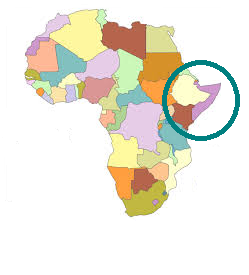
The Horn of Africa is the most eastern part of Africa that sticks out into the ocean like a rhinoceros horn. It is sometimes known as the "Somali Peninsula," touching the Red Sea, The Gulf of Aden, and the Indian Ocean. It includes the countries of Ethiopia, Eritrea, Djibouti, Somalia, and Northern Kenya.


In recent history, Somalia has had many civil wars and tribal conflicts that have caused many divides in the country, with different tribes claiming certain regions attempting to create separate countries. The most commonly known territory is the de facto state of Somaliland, in the northern part of what most people know as Somalia. It is considered  "de facto," meaning that it exists in reality, even though the country itself is not recognized by law. Somaliland declared itself independent from Somalia in the early 1990s. However, it is not yet recognized as an official country by UN standards. But it does have its own government, land borders (though disputed) and requires a separate visa to travel than Somalia. A few years later, "Puntland" also declared itself an autonomous state of Somalia. However, it is not seeking recognition as its own country. Puntland does have a president and parts of a working government but also adheres to and is still considered part of Federal Somalia.


Map: www.bbc.com.uk


 This is all a bit confusing, I know! The most important thing to remember is that Somali, Somaliland, Puntland, and the general region of the Horn of Africa is that the tribes and clans are truly the ones who control the area. All of the borders you see on typical maps are not often recognized or upheld by the local people. The clan elders and their relationships with other clans determine reign and rule in the region. What land belongs to what clan can change if there is a conflict between the clans. This brings us to our next point:

Who are Somalis?

Somalis are the people who descend from the Somali region of the Horn of Africa. There are many Somali people around the world, most of whom started out as displaced people or refugees who fled from civil conflict taking place in Somalia.

Depending on who you talk to, "Somali" is made up of the Somali words "soo" and ‘maal," meaning "go and milk," referring to their camels, goats, or cows. Though like much of Somali culture, that too is disputed! Some say "soo" and "maal" mean "from fortune," pointing out that Somalis have a lot of wealth in their herds. Either way, both definitions allude to the Somali people and their herds. They are well known for their herds of camels. They come from a background of being nomadic herders, taking their animals to where there is grass and water. Now, there are more traditional cities and villages, and the people are generally more settled and only send their herds out close to home.

The Somali tribes are made up of five prominent clans. As previously mentioned, the clans make up the central part of Somali culture and politics; the clan leaders rule and reign. Clan ties are passed down from the father.

The majority of Somalis are Muslim. Historically they have been called the "Protectors of Islam." Though they follow the teachings of Muhammad, most also put their faith in sheik's or medicine men, who make amulets, often using the verses of the Qur’an as spells for protection. This need for security is based on their fears of the evil eye or curses from others.

These deep Islamic roots bring us to What?

What exactly is the goal of moving to this region and spending so much time learning the culture and the language? Our goal is to see a disciple-making movement among the Somali people. Our biggest hope and prayer is that Somalis will give their hearts to Jesus and surrender to following Him, becoming a disciple who shares this new faith with others.

When we say disciple, we mean both the noun and verb form. We want to see devout disciples who desire to study the ways of Jesus, take on and embrace their new identity in Him and follow in His footsteps by encouraging and raising up others who also desire to follow Him.

How?

How are we going to see this movement happen? First, we pray! We cannot make any plans that will force this to occur among these people in this region- Only the Father can soften their hearts, open their minds, and give them ears to hear the True Gospel! We have, and we will continue to posture our heart toward the Father, lean on Him, listen closely for His voice, and follow His leading as we take steps toward this goal.

If you’d like to learn more details about how we are going about this, sign up for our newsletter!

Newsletter

Monday, January 24, 2022

Our Story

 Every couple has their own love story, and ours is pretty unique! Fuzzy and I had our fair share of broken hearts and failed relationships in the past, primarily due to our desire to live overseas and share Truth with the unreached. Most people don’t jump at the thought of giving up “The American Dream,” leaving family and friends in America to tough it out in remote places in Africa; oddly enough, that is precisely what drew Fuzzy and I together.

I felt confident that coming home to settle down in America wasn’t for me at this time. I was living and working in North Africa, finally realizing that after a few two-year terms on the mission field, it was time to commit my heart to be a full-time missionary. Fuzzy had come to this decision years before I did and assumed that marriage would not be in the cards for him unless he found a girl willing to do life in the Horn of Africa.

Fuzzy was in the states preparing to return to The Horn, and I was halfway through my second term in North Africa. We found ourselves on a website designed for single missionaries to meet and share each other’s callings. We exchanged a few messages on the website and found out that we both have the heart and desire to live and serve in Africa.

We decided to try a video phone call to see if we had any spark- the first call lasted for three hours! How did the African internet withstand such a long call? - To this day, I have no idea! But I know that my face hurt from smiling so much after the call!

We spent many early mornings and late nights sharing our hearts, love for Our Father, and desire to see the unreached reached connected us even though we were countries and oceans apart. After a few weeks of talking on the phone almost daily, Fuzzy wrapped up his time in the states and prepared to return to Africa on the first of the year. Not knowing if or when we would be able to meet in person, Fuzzy took a giant leap of faith and purchased an engagement ring before flying out of the country, just in case he might need it in the coming months.

Our schedules conflicted; we could not find a way to meet in person until early spring. Even then, it wasn’t without drama. In March, April, and May between the both of us, we had a few 12-hour bus rides, one spurt of house arrest, one revoked visa,  6 flights, 4 passports, 6 approved visas, many dropped phone calls, a few tears but ended with a thriving relationship and one marriage proposal! Missionary dating is not for the faint of heart! 

We thought dating across countries, continents,  and time zones was challenging, but wedding planning was much more complicated. Somehow, with the help of family and friends, we managed to pull together a beautiful woodsy wedding at the close of the summer. The few weeks leading up to our wedding was the most time Fuzzy, and I had spent together, in the same place at the same time- like I said, our love story is unique, but I’m so happy it’s ours.


The Long Awaited Blog Post

 Hi Friends! 

If you have been following Fuzzy and me for any about of time, you may have noticed a little button on our website that linked to this blog. For the last two years, I have been meaning to write blog posts, sharing stories with you about our life overseas-as you can see this is the first one to actually make it to the interweb. 

Without fail, I would sit down and write a story, a story about something that happened, a cool new cultural experience, or a lesson God was showing me.  I would read and edit it and think that I was all ready to hit PUBLISH, then be completely overcome with anxious thoughts.

No one wants to read this!
There are too many grammatical errors! 
This story/life is not as interesting as so many others out there!
I am a poor writer!

The list could go on, but I think you get the point.  I really do enjoy writing, and sharing stories. Telling stories is so much a part of who we are as people! I do hope that the stories I share here will be interesting to you and that you will be gracious to me (and all my errors) as I try to be more intentional about sharing little glimpses of our life overseas.  

Living in Community

  "Living in Community" or "doing life together" are buzzwords in the Body of Christ these days. And in theory, it sound...